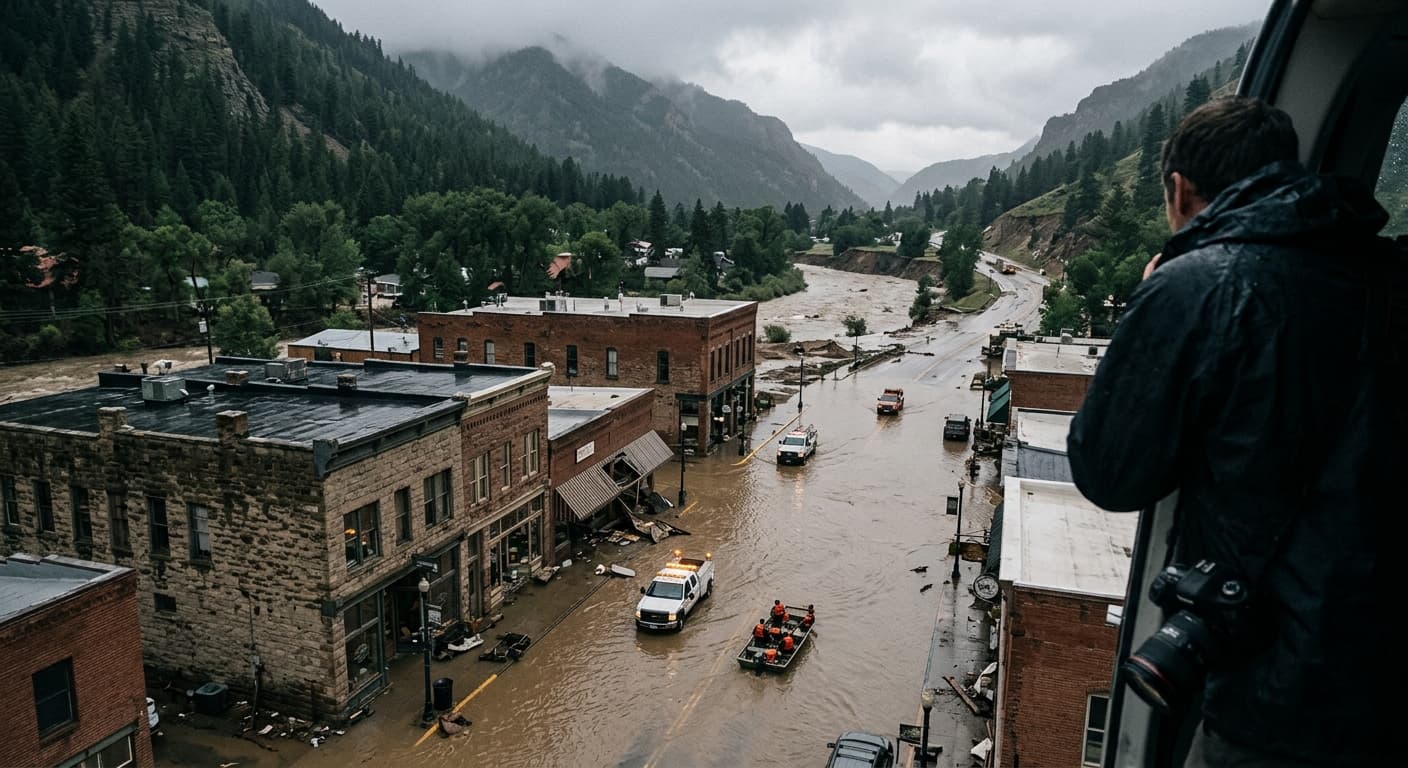
When Hurricane Helene made landfall in Florida's Big Bend on the night of September 26, 2024, the greatest damage didn't happen along the coast. It happened hundreds of miles inland. Within a day, record rainfall and flooding overwhelmed Asheville, North Carolina. Biltmore Village and the River Arts District, two long-standing commercial corridors, were largely destroyed. Ground-floor retail, restaurants, galleries, and offices that had operated for decades were inundated or swept away as the French Broad and Swannanoa Rivers surged.
The financial impact was severe. Helene caused an estimated $78.7 billion in damage nationwide, making it one of the costliest Atlantic hurricanes on record. Asheville-area tourism revenue was projected to drop by $585 million in the first quarter of 2025 alone. Yet only about 2% of households across the disaster-declared counties in North Carolina, South Carolina, and Georgia carried FEMA flood insurance, and in many of the hardest-hit inland counties the share was well under 1%. Commercial property owners were left with limited options for recovery.
By traditional measures, Asheville looked like a low-risk market. It's far from the coast and outside commonly mapped flood zones. That assessment didn't hold. This is the shift property managers are now facing. Climate, insurance, energy, and regulatory risks are showing up across most U.S. commercial and multifamily portfolios. Planning for them is no longer separate from day-to-day management.
For years, sustainability in real estate management was treated as a value-add. Owners who wanted certifications pursued them. Owners who didn't, didn't. That framing no longer fits today's risk environment. By 2026, climate-related and regulatory risks affect most U.S. commercial and multifamily properties in ways that are financially and operationally material. Sustainability planning is now part of basic risk management.
About 30-35% of U.S. commercial floor area and 25-30% of institutional multifamily units are covered by mandatory energy benchmarking. Penalty-bearing Building Performance Standards programs already affect 15-20% of institutional commercial space and 10-15% of institutional multifamily, including many major office markets. Virtually all institutional commercial and multifamily assets face rising premiums, tighter terms, or reduced capacity on property insurance. Insurance costs now average 2.4% of property income nationally and reach 4-5% in some storm-exposed metros.
Multifamily premiums continued to rise sharply in 2024. Regional surveys, such as the Federal Reserve Bank of Minneapolis's survey of Upper Midwest owners, reported average year-over-year increases of roughly 45%, while national same-store benchmarks showed more moderate increases of 12-28%. Roughly one in five commercial and multifamily properties faces severe or extreme hurricane wind risk. Severe convective storms affect most properties east of the Rockies, with hail risk particularly acute in central U.S. industrial corridors.
Around 5-8% of commercial buildings and 10-15% of multifamily units are located in elevated wildfire zones. The Wildland-Urban Interface now contains nearly one-third of U.S. housing, with institutional exposure concentrated in the West and parts of the Southeast. An estimated 40-50% of U.S. commercial and multifamily properties are in markets with recurring moderate or worse drought conditions. The most financially material impacts are concentrated in the Southwest and parts of California, where water restrictions and development limits are increasingly common.
About 6% of properties fall within FEMA Special Flood Hazard Areas. When rainfall-driven flooding is included, long-term flood risk rises closer to 20%. Nationally, hundreds of thousands of commercial and multi-unit residential properties face material flood exposure. All properties face higher cooling loads and HVAC stress. By the early 2050s, roughly one-quarter of U.S. commercial and multifamily space is projected to sit within an Extreme Heat Belt stretching from Texas to the Great Lakes.
More than half of U.S. commercial and multifamily properties are in regions classified as high risk for power supply shortfalls through 2030. Nearly two-thirds are in regions rated elevated or high risk, increasing the importance of energy resilience and operational continuity planning. While landslide exposure affects a smaller share of buildings overall, about 3-5% of commercial buildings and up to 10% of multifamily units face elevated risk, primarily in hillside and coastal-bluff markets. By 2050, only a small percentage of properties are directly exposed to sea level rise by count, but a much larger share by asset value due to premium waterfront pricing.